
Not Your Outage. Still Your Problem.
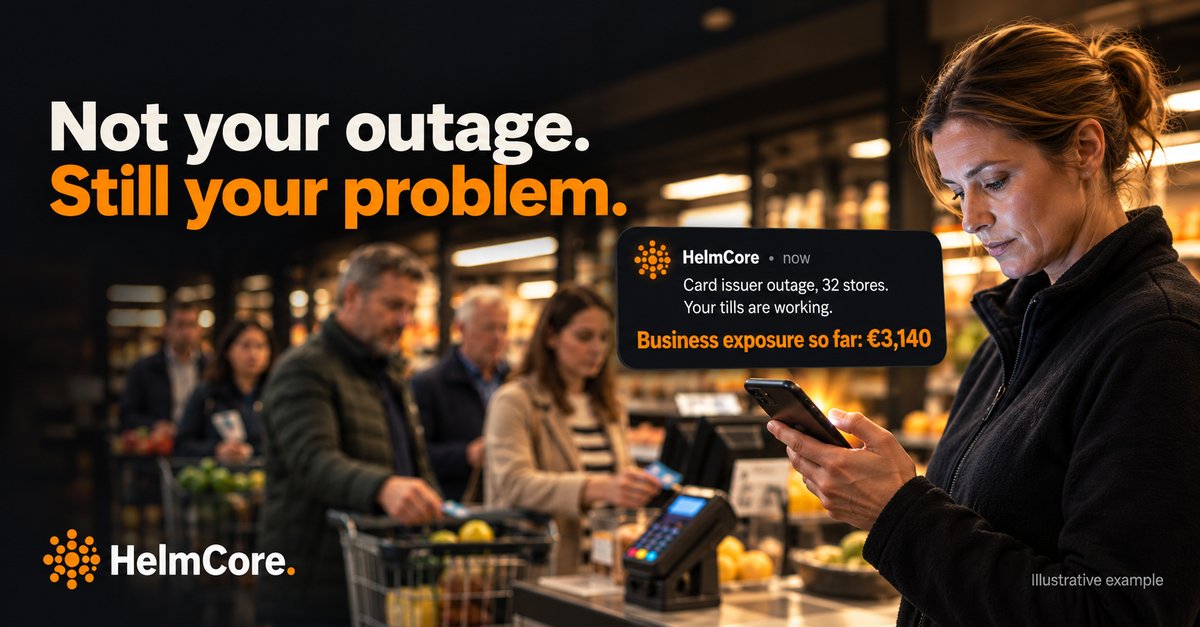
Picture a checkout in an Irish store on the morning of Tuesday 20 October.
A customer taps a Revolut card. It fails. She tries again. It fails again. The colleague on the till apologises, reboots the terminal and calls over the store manager. By now there are six people waiting.
Nothing in that store had broken. The terminals were healthy and the network was up. The cause was a Google Cloud incident in London that took out Revolut's card payments, app and transfers for hours. Customers of several UK banks reported problems in the same window.
Not your outage. Still your problem.
I spent the best part of a decade working with Irish retailers before we built HelmCore, and I've seen this pattern more times than I can count. Something fails outside the business, and the business spends the next hour proving it isn't them.
So here's an exercise for every multi-site retailer. Go back to that Tuesday morning and count the minutes.
Start with the first clock: the time between the first failed card and your IT team knowing the fault wasn't yours. In most estates, those minutes go on calls from stores, terminal reboots, checks with the payment provider, checks on the network, and eventually someone spotting the news. Every one of them is your IT team investigating systems that were working.
Then the second clock: the time before your store teams could tell customers, with confidence, that the problem sat with the card issuer. Until that moment, colleagues are guessing. Some reboot. Some apologise for a fault that isn't theirs. Some say nothing and watch the queue grow. One clear line, "please try another card, the issue is with the bank", changes that conversation completely.
The pattern behind both clocks is simple. A spike in declines from one card issuer across many stores at once, while every other card goes through, tells you the terminals are working and the fault sits upstream. From behind a single till, it looks like a broken terminal. Across the whole estate, the answer is clear within minutes.
Now the third number, the one that matters most: what you lost while both clocks were running.
The abandoned baskets. The customers who walked out rather than wait. The engineer call that should never have been booked. The hours your IT team spent on a problem they could never fix. Add it up by store and by the hour, and for most estates it's a figure nobody has ever calculated, because the incident was logged as someone else's outage and closed.
That's the real cost of third-party failure. Every retail estate now trades on a chain of card issuers, acquirers, cloud providers and connectivity providers, and any of them can fail on a Tuesday morning. You can't prevent their outages. You can shorten the time it takes to know, the time it takes to tell your stores and customers, and the time it takes to put a number on it.
It's the problem we built HelmCore around. It correlates what's happening on the tills and the network across every site, separates an issuer-side decline pattern from a terminal fault, tells store teams exactly what to act on, and shows the financial impact of each incident in real time, based on the retailer's own figures.
Businesses don't invest in technology to monitor technology. They invest in it to trade. On 20 October, the retailers who knew fastest lost least.

Latest insights and trends




See what's happening across your estate, in real time