
How to Calculate the Cost of an IT Incident per Store
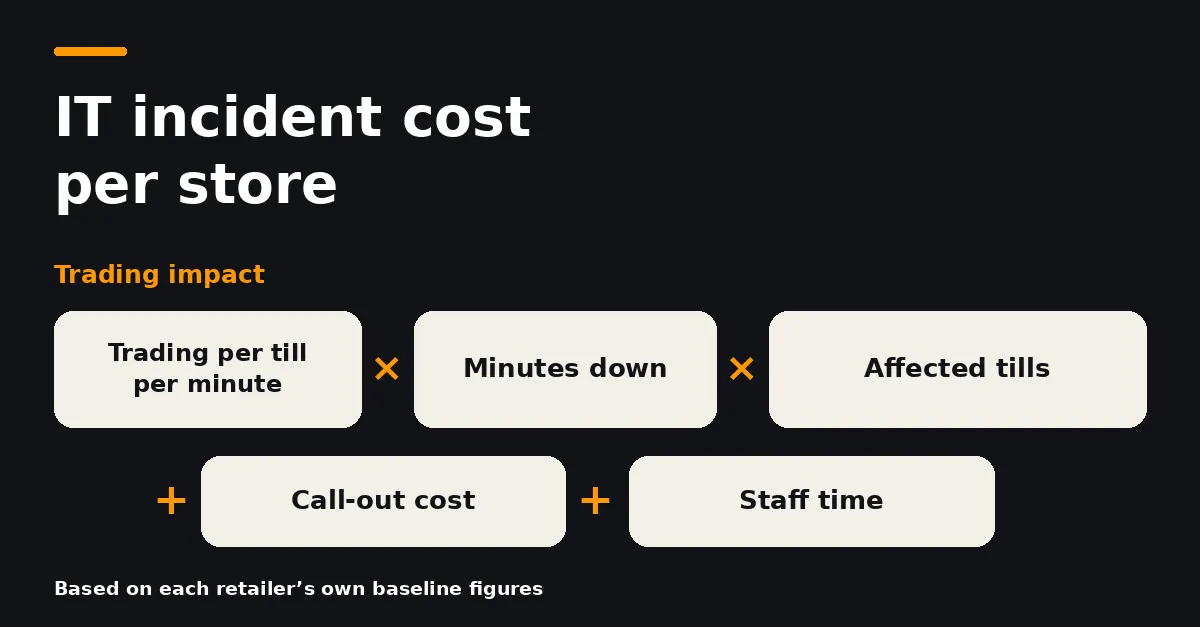
To calculate what an IT incident costs a store, multiply its trading per till per minute by the minutes the tills were down and the number of tills affected. Then add the engineer call-out cost and the staff time the incident took up. The result is a cost you can defend in a finance meeting.
If you lead finance, operations or IT for a multi-site retailer in Ireland or the UK, this turns “POS down, 45 minutes” into a cost the whole business understands.
The four cost lines in a store incident
Every store incident carries the same four costs. Two come from lost trade and two come from the effort of putting it right.
Lost transactions. When tills or card payments fail, sales that would have gone through stop.
Abandoned baskets. A queue behind a failing till costs more than that till’s sales. Customers put down full baskets and walk out.
Staff time. Store teams stop serving to restart terminals and manage the queue, while central teams diagnose the fault and coordinate the fix.
Engineer call-outs. A site visit has a direct cost, and a visit that arrives without the right part adds a second one.
A step-by-step method
The formula brings the four lines together:
Incident cost = (trading per till per minute × minutes down × affected tills) + call-out cost + staff time
The first part of the formula covers lost transactions and abandoned baskets together, because both are trade the till would normally have taken. Work through it in six steps.
- Work out trading per till per minute. Divide the store’s takings for a trading period by the number of tills, then by the minutes in that period. Use the same day of the week and time of day as the incident where you can, because a Saturday afternoon trades very differently from a Tuesday morning.
- Measure the minutes down. Count from the moment the fault started affecting trade to the moment the fix was confirmed. Measuring from when someone reported it understates the cost.
- Count the affected tills. Include tills that were slow or declining cards as well as tills that were completely down. A slow terminal loses trade before it ever goes offline.
- Multiply the three. This gives the trade lost during the incident.
- Add the call-out cost. Use your contract rate, or the invoiced cost if you have it.
- Add the staff time. Multiply the hours spent in store and centrally by a loaded hourly rate for each role.
A worked example (illustrative)
The figures below are illustrative only. They are round numbers chosen to show the method and do not describe any real retailer.
A store takes EUR 43,200 across six tills on a Saturday, over 12 trading hours (720 minutes). Its trading per till per minute is EUR 43,200 / 6 / 720 = EUR 10.
At lunchtime, card payments fail on four of the six tills for 45 minutes.
- Lost trade: EUR 10 × 45 minutes × 4 tills = EUR 1,800
- Engineer call-out: EUR 250
- Staff time: two people for 1.5 hours at EUR 20 an hour = EUR 60
The incident cost that store EUR 2,110. If the same fault came from a shared payment provider or network link and hit ten stores at once, the business would be looking at more than EUR 21,000 from a single cause.
Where the manual method falls short
Calculated by hand, the figure arrives days after the decisions it should have informed. Minutes down are estimated from help desk logs, and across a large estate nobody has time to work it out for every incident, so the costliest problems are not always fixed first.
How HelmCore calculates the impact of each incident
HelmCore shows the financial impact of each incident in real time, based on your own baseline store figures. Your team provides and validates those figures, and the cost shown rises while the incident stays unresolved.
The rest of the formula comes from the platform itself. HelmCore detects problems within minutes, with no phone call needed, and each incident names the site, the device and the fault. Related alerts are grouped into one incident per real problem, so a payment fault affecting several tills or stores is counted once. HelmCore pinpoints the most likely cause, tells your team exactly what to act on, and closes the incident once the fix has been verified. That gives you a measured start and end for every incident, and a cost based on your own figures.
Finance, operations and IT see the same incident and your business exposure across the estate, so the costliest problems are fixed first. Measure your technology by what it does for your business.
To see what incidents are costing your stores, Request a Retail Visibility Review.
Frequently asked questions
What should be included in the cost of an IT incident per store?
Include lost transactions, abandoned baskets, staff time in store and centrally, and any engineer call-out.
How do you measure how long a store incident lasted?
Measure from the moment the fault started affecting trade to the moment the fix was confirmed, not from when the store reported it.
Does the cost of an incident change at peak trading times?
Yes. Trading per till per minute is far higher at peak times, so base the calculation on the same day and time of day as the incident.
How does HelmCore calculate the cost of each incident?
HelmCore shows the financial impact of each incident in real time, based on baseline store figures your team provides and validates. The cost rises while the incident stays unresolved.

Latest insights and trends



See what's happening across your estate, in real time