
Floppy Disks, Fibre and the Risk Inside Every Upgrade: What Multi-Site Retail Can Learn from US Air Traffic Control

If you run IT for a multi-site retail estate, the US air traffic control upgrade now making headlines deserves a place on your reading list. The Federal Aviation Administration (FAA) is replacing systems that still depend on 3.5-inch floppy disks. On 13 November, during work to swap old copper telecoms lines for fibre, departures across the US were halted for more than four hours in only the second nationwide ground stop since 2001. The lesson for retail is direct: the most exposed period for any distributed estate is the change itself, when new technology and legacy technology run side by side.
What the FAA is replacing
The FAA is retiring four legacy systems that hold critical operational data on floppy disks. According to New Atlas, these systems carry real-time weather reporting, restricted airspace information and system configurations, and they run on programming languages including Ada, Fortran and early C.
The practical problems will be familiar to anyone who manages ageing equipment. Floppy disks degrade after around 15 years. Replacement parts grow scarcer every year. Moving data between parts of the system often means carrying disks from one machine to another and working from paper flight strips.
The replacement is the Enterprise Information Display System (E-IDS), due across 435 facilities by the end of 2028. It brings weather and operational data into a single display for controllers, swaps manual transfers for digital data streams, introduces IP voice switches and replaces copper telecoms wiring with fibre. Alongside it, an AI-assisted platform called SMART analyses flight and weather data to predict airspace congestion before delays spread.
The upgrade carries its own risk
The 13 November ground stop shows where the danger sits. US officials said that during work to replace copper lines with fibre at one remote site, a router began flooding the FAA’s telecoms network with more than 1,000 connection attempts every four to five seconds, and equipment across the system became unstable. One change, at one point in the network, stopped departures across the country.
This is the pattern to plan for. Modernisation is the right decision, and the FAA’s programme will give its controllers faster, clearer information. The transition period, though, creates new interactions between systems built decades apart, and those interactions are where faults appear first.
Your estate runs on a mix of old and new
Multi-site retail looks a lot like air traffic control in this respect. Your estate is a blend of technology generations: POS terminals bought in different refresh cycles, payment terminals, self-checkouts, Wi-Fi access points, network switches, refrigeration controllers and, increasingly, smart trolleys and electronic shelf labels. Every store has a slightly different combination, and a refresh rolls out site by site over months.
During that rollout, two generations of technology share the same network. A new switch, a firmware update or a fibre migration at one site can affect the applications your stores trade on: payments, POS, stock and pricing. Your customers see the result at the till as a slow card payment or a frozen screen, long before anyone sees the network event that caused it.
The cost lands on trading. A lost sale in a convenience store or on a forecourt rarely comes back later, and every engineer visit to confirm a fault adds to the bill.
Four lessons for your next technology refresh
1. Watch the applications, and treat the signals as evidence
The FAA’s new display brings scattered data into one view for the people who need it. Apply the same principle to your estate. Measure how payments, POS, stock and pricing perform at every site, and use the signals underneath, from network equipment, PCs, IoT devices and energy systems, as the evidence of what is wrong.
2. Make every change visible
When a fault follows a change, the fastest route to the cause is a clear record of what changed, where and when. Keep a timeline of changes to ports, routes and software alongside your incidents, so your team can connect a slowdown at the till to the update that came before it.
3. Expect a fault to travel
A single component at a single site can affect many others. Correlate signals across sites so related alerts arrive as one incident per real problem, with the site, the device and the fault named. Your team starts work on the problem straight away.
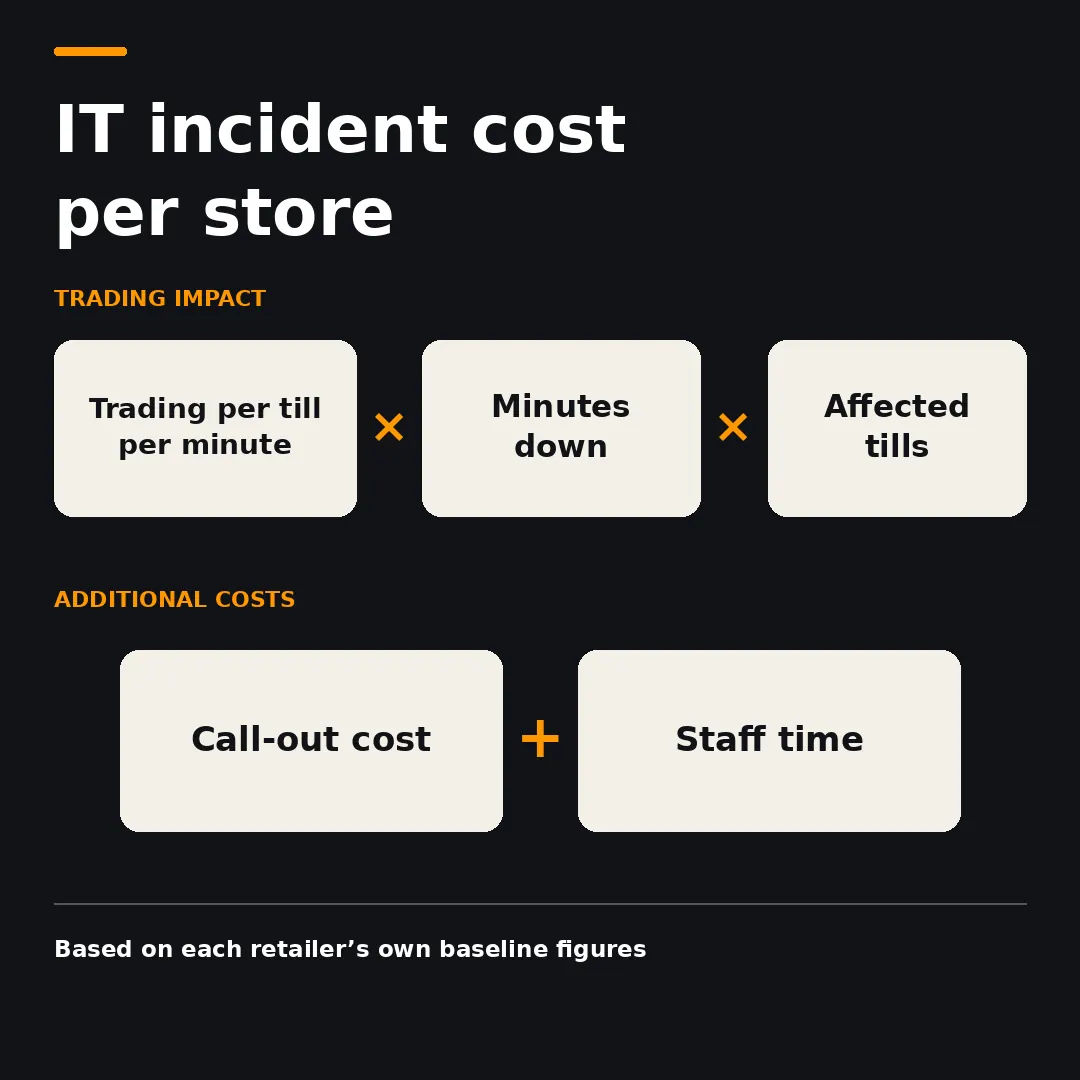
4. Put a cost on disruption as it happens
Every open incident carries a cost, and that cost rises while the problem stays unresolved. Seeing it in real time, in euro or sterling, lets your team start with the incident that matters most to the business and gives finance and operations the same picture as IT. To see what an hour of disruption could cost across your stores, try our Financial Impact Calculator.
Why the timing matters now
Black Friday falls on 27 November. Peak trading puts every part of your estate under load at once, and a weakness that goes unnoticed on a quiet Tuesday can show up as slow payments across dozens of stores on the busiest day of the year. Many retailers will also have completed hardware or software changes during the autumn, ahead of their change freeze. The weeks before peak are a good time to check that you can see how your critical applications perform at every site.
How HelmCore helps
HelmCore is an Operational Impact Intelligence platform for organisations running distributed operations, starting with multi-site retail. It works in five steps:
- Detect. Problems found within minutes, with no phone call from the store needed.
- Understand. Each incident names the site, the device and the fault, and pinpoints the most likely cause.
- Prioritise. HelmCore shows the financial impact of each incident in real time, based on your own baseline store figures, rising while it stays unresolved.
- Act. Your team is told exactly what to act on, and some corrective actions run automatically, depending on the action.
- Verify. HelmCore verifies the fix, then closes the incident.
During a refresh, HelmCore records what changed, where and when alongside each incident, so your team can trace a slowdown at the till to the change that came before it.
It runs on the technology you already have: a small program on your existing Windows machines, plus the monitoring built into your network equipment. Each customer runs on their own single-tenant instance, and HelmCore is ISO 27001 certified.
Know what disruption costs your estate
The FAA’s upgrade is a reminder that modernisation and visibility belong together. Before your next refresh, or before peak trading, it helps to know what a fault at the till would cost your business. Our Financial Impact Calculator lets you model that cost from your own store figures in a few minutes.
Try the Financial Impact Calculator
Measure your technology by what it does for your business.
Sources: New Atlas, US air traffic control finally bids farewell to the floppy disk era, 14 November 2026; NPR, FAA blames Friday’s ground stop on ‘equipment issue’ during telecoms network upgrade, 14 November 2026; Scripps News, What caused the FAA ground stop? Officials point to router failure, November 2026.

Latest insights and trends



See what's happening across your estate, in real time