
What the Microsoft 365 Outage Teaches Multi-Site Retailers About Supplier Failure

For IT and operations leaders running a multi-site retail estate, the Microsoft 365 outage of 12 and 13 November carries one clear lesson. When a supplier fails, how much it costs you depends on how quickly you can see what is failing, and where. A single hidden fault spread across 74 countries, and in the first hour thousands of people pointed at the wrong service. Retail estates see the same pattern every week, at the scale of a payments slowdown or a carrier fault.
Microsoft 365 was down for most of a day across 74 countries
Microsoft’s final report puts the start at 16:20 on Thursday 12 November, Irish and UK time, with the impact ending at 16:10 on Friday 13 November. Clearing the email backlog took longer, and Microsoft declared the incident resolved in the early hours of Saturday 14 November. The disruption reached 74 countries, and Microsoft said there was no evidence of a cyberattack.
The effects reached well beyond email. One major UK supermarket reported problems with online customer registrations, password resets and email changes, and rail operators were unable to send emailed ticket confirmations. Some businesses went back to fax machines to confirm trades.
Three small factors combined into a global outage
It took three things together to turn a hidden fault into a global outage: a dormant defect, a routine traffic change and a system already under strain. The defect had slipped into an earlier fix to Microsoft 365’s networking gateway servers. On 12 November, a routine switch of Teams traffic added load to servers that were already running at reduced capacity because of an unrelated issue.
Exchange Online servers then failed their automated health checks and dropped out of service. That pushed more load onto the servers that remained, until those were overwhelmed too. The safeguards that normally contain a failure did not hold, so the cascade kept spreading.
The first reports blamed the wrong service
In the first hour, the symptoms pointed in several directions at once. As the outage began, Downdetector reports spiked for Azure, OneDrive and Microsoft Store as well as for Outlook and Teams. Microsoft described the incident as a multi-region issue disrupting several Microsoft 365 services, primarily Exchange Online.
People reported the services they could see failing. The fault sat in one place underneath all of them, in the gateway servers that carry Exchange Online traffic.
One supplier failure shows up as dozens of store problems
A supplier fault in a retail estate spreads the same way. Picture 4:55pm on a Friday. Your payments provider starts to slow, card transactions take longer at dozens of stores, queues build, and store managers start ringing the service desk.
Each call becomes its own ticket. The network team checks the store links, the POS supplier checks the terminals, and someone asks whether the new till software is to blame. Every store describes it differently: slow tills, a frozen screen, a card machine asking customers to try again. Store teams handle the queue, engineers wait to hear where to go, and trading slows across the estate.
The more suppliers your estate depends on, the more places those symptoms can appear. In many estates that list covers payments, POS, stock and pricing systems, network carriers, and the Microsoft 365 email and messaging that stores use to take orders, check rotas and hear from head office.
The first question is whether the fault is local or estate-wide
Your team’s first job in any outage is to work out whether the fault sits at one store or with a supplier across the estate. That answer decides who you call, what you tell the stores, and whether an engineer goes anywhere.
The pattern across your sites gives you the answer. If every store shows the same slowdown at the same moment, the problem sits upstream with a supplier. If one store is struggling while the rest trade normally, the problem is local. If a group of stores on the same network carrier is affected, you know where to look next. We covered the same pattern after the October card payment outage in Not Your Outage. Still Your Problem.
Working this out by phone, ticket by ticket, takes time, and the queues keep growing while it happens. The stretch before anyone knows what is failing is where an outage costs the most trading time.
HelmCore for Retail shows what is failing, where, and what it costs
HelmCore is an Operational Impact Intelligence platform, and HelmCore for Retail is configured for multi-site retail estates. It starts with the applications your stores trade on: payments, POS, stock and pricing. It measures how each one performs at every site, and it uses the signals underneath, from network and devices to IoT and energy, as the proof of what is wrong and what it costs. It works in five steps.
- Detect. Problems are found within minutes, with no phone call needed. HelmCore measures how quickly named business applications respond from each site, and raises an incident naming the service, the site and the machines affected when a limit is crossed.
- Understand. Related alerts are grouped into one incident per real problem, so 40 stores reporting slow payments appear as a single incident. Each incident points to the likely cause, and shows whether the same problem is appearing at every site or at one.
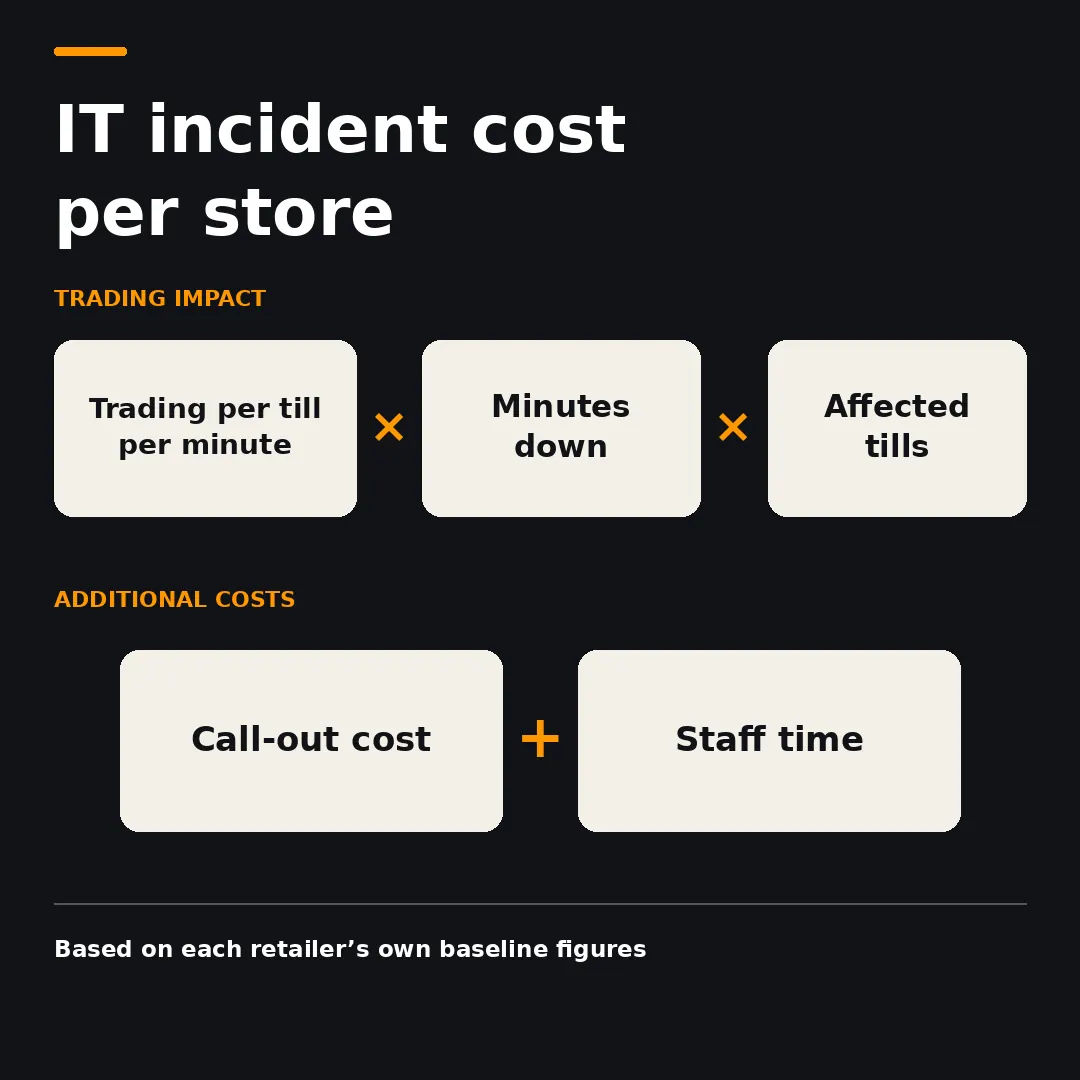
- Prioritise. HelmCore shows the financial impact of each incident in real time, based on your own baseline store figures. Operations and finance see the business exposure as it builds, and the costliest problems go first.
- Act. HelmCore tells your teams exactly what to act on, and carries out some corrective actions itself, depending on the action.
- Verify. HelmCore verifies the fix, then closes the incident, so you see the moment the cost stops.
Microsoft 365, measured from every site
The same applies to Microsoft 365. HelmCore measures how Microsoft 365 performs from every site and shows every Microsoft 365 application in use across your estate, from Outlook and Teams to SharePoint. When something slows or stops, it pinpoints where the problem sits: in a store’s network, on your own servers, or in a wider Microsoft outage. On a day like 12 November, your team knows within minutes that the fault sits with Microsoft, and can tell every store the same thing straight away.
HelmCore runs on the technology you already have, with no new hardware. It brings in the monitoring tools you already run, set up when you need them.
Three tests show how ready your estate is for the next supplier outage
Run your last supplier outage back through these three tests. The answers show where your estate loses time and money.
1. Count what every store depends on
List each supplier and cloud service your stores need to trade, from payments and POS to Microsoft 365 email and messaging. Then count how many of them your team can see from one place.
2. Time how long it took to know
Go back to the last outage and measure the gap between the first failed transaction or email and your team knowing whether the problem sat at one store or with a supplier. That gap is where the trading time goes.
3. Check whether anyone could say what it cost
Ask whether anyone could put a figure on the lost sales, store time and engineer visits while the outage was running, or even a week later.
HelmCore answers all three as an outage happens: every business application, Microsoft 365 included, measured at every site in one view, the estate-wide pattern within minutes, and the financial impact of each incident in real time.
Speed of understanding decides the cost of the next outage
Supplier outages will keep happening, to Microsoft and to every other provider your estate depends on. What you control is how quickly you know, how clearly you see what it is costing, and how fast the right team gets to work.
Businesses don’t invest in technology to monitor technology.
To see how your estate scores on all three tests, book a free Retail Visibility Review.
Book your Retail Visibility Review
Sources: 365Fanatic, Microsoft 365 outage of 12 and 13 November 2026: the final report; SlashGear, We now know what really caused Microsoft’s massive November outage; Control Plane, What caused the Microsoft 365 outage of November 12, 2026; City AM, 13 November 2026; XenoSpectrum, Microsoft 365 outage and Exchange dependency; Search Engine Roundtable, Microsoft 365 outage impact on Microsoft Advertising; Crypto Briefing, Microsoft 365 outage passes 12 hours, hitting users in 74 countries.

Latest insights and trends




See what's happening across your estate, in real time